

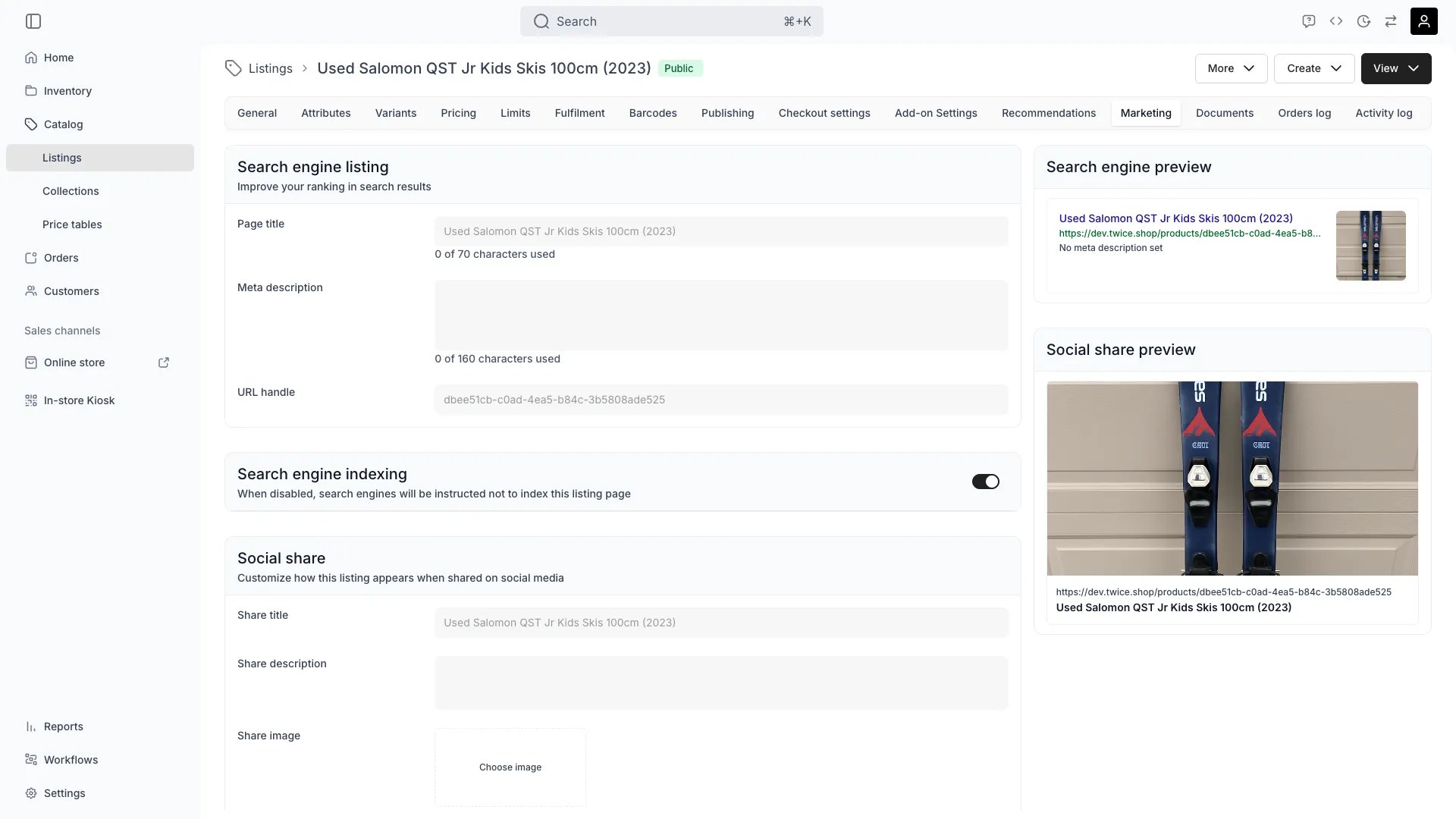
Catalog > Listings > [Listing] > Marketing
Search engine listing
Use these fields to optimize how your listing appears in search results.Canonical URLs
The storefront automatically generates<link rel=”canonical”> and og:url meta tags for each listing page. If you have a primary custom domain configured, canonical URLs point to that domain. When a listing is reachable at an alternate slug or the TWICE subdomain, the canonical tag directs search engines to the primary URL, preventing duplicate-content issues.
URL slugs
Each listing can have multiple URL slugs. The first slug is the primary slug — the canonical URL for the listing on the storefront (e.g./products/blue-alpine-skis). Any additional slugs are alternates that also open the listing but carry a rel=canonical tag pointing search engines to the primary.
Slugs are normalized automatically: lowercased, Latin accents folded to ASCII (e.g. ä becomes a), whitespace replaced with hyphens, and capped at 120 characters. Non-Latin scripts (e.g. Chinese, Cyrillic) pass through unchanged. UUID-shaped values are rejected because they would conflict with internal resource IDs.
When you create a listing without a slug, one is auto-generated from the listing name. If the generated slug is already taken by another listing in the same workspace, a short random suffix is appended.
A listing without any slugs uses its UUID in the storefront URL. Adding a slug gives you a human-readable, shareable URL.
Social share
Control how your listing appears when shared on social platforms. These settings define the title, description, and preview image used in link previews.
Social share content is automatically used when links are shared to platforms like Facebook, X, or LinkedIn.
Agentic Commerce optimization
Agentic Commerce means making your listings readable and actionable for AI systems — enabling agents to understand what’s offered and when it’s available. Here’s how to optimize for that:- Keep attributes structured. Use clear naming for specifications, variants, and price details so agents can interpret them correctly.
- Describe value in plain language. Meta descriptions and titles say what the product or service is.
- Use relevant keywords. These improve both human and AI search performance.
- Maintain accurate inventory and pricing. Agents rely on real-time availability and consistent data structure to make recommendations or transactions.
Summary
Marketing settings define how your listing is seen by both people and machines. They help your products:- Rank higher in search results.
- Look better when shared socially.
- Stay discoverable and actionable in AI-powered commerce.