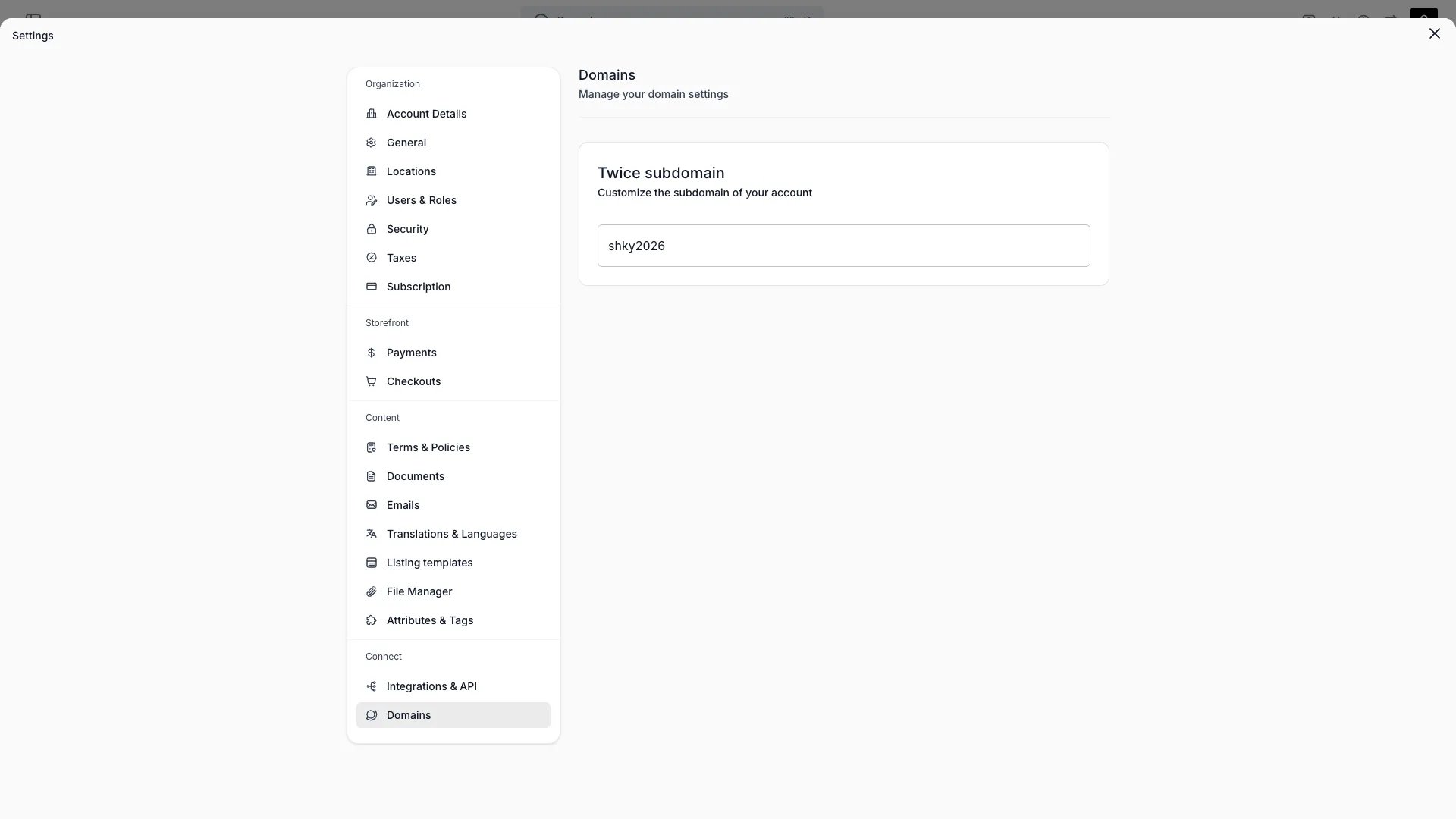
Every store has a TWICE subdomain (for example yourstore.rentle.store). You can change the slug. Changing it breaks existing links to the old address — there is no automatic redirect.
Custom domain
Connect your own domain: add it, update your DNS as instructed, and TWICE Commerce issues the TLS certificate automatically. Track its status (needs setup → pending → active) and set one domain as primary.
Primary domain and SEO
Mark one custom domain as primary to consolidate your store’s SEO signals. The primary domain drives three automatic behaviors:
Canonical URLs — every indexable storefront page emits a <link rel="canonical"> tag pointing to the primary custom domain. When the same page is reachable at both yourstore.twice.shop and yourdomain.com, search engines treat the custom domain URL as the authoritative version, avoiding duplicate-content penalties.
Open Graph URLs — the og:url meta tag uses the primary custom domain, so social previews and link shares always reference your custom address.
Admin-generated links — checkout links, store preview buttons, and share links in the admin use the primary custom domain instead of the TWICE subdomain.
Non-primary custom domains, alternate slugs, and the TWICE subdomain still resolve to the correct page — their canonical tags point crawlers to the primary domain URL.If you remove or deactivate the primary domain, URLs revert to the TWICE subdomain.
Canonical and Open Graph tags apply to all public storefront pages (home, listings, collections, about, terms, privacy). Cart, checkout, and preview pages are excluded.
Your TWICE subdomain is available on every plan. Custom domain availability depends on your plan — see pricing.
Go to Settings → Domains and click Connect a domain. Enter the hostname you want to use (for example shop.yourbrand.com or yourbrand.com). TWICE validates the format and creates a domain record with status Needs setup.
After adding the domain, TWICE opens a setup dialog showing the DNS records to add at your registrar.
Type
Host
Value
CNAME
Your subdomain (e.g. shop) or @ for root domains
domains.twice.shop
Add this CNAME record at your domain registrar (e.g. Cloudflare, GoDaddy, Namecheap, Route 53). The Host field depends on whether you are connecting a subdomain or a root domain:
Subdomain (e.g. shop.yourbrand.com) — set the host to the subdomain label (shop).
Root domain (e.g. yourbrand.com) — set the host to @. Your registrar must support CNAME, ALIAS, or ANAME records at the zone root. The setup dialog warns you if you are connecting a root domain.
DNS changes can take up to 24 hours to propagate, though most providers update within minutes.
Once you have added the DNS record, return to the setup dialog and click Verify. TWICE checks that the hostname resolves correctly:
If the DNS records have propagated, TWICE registers the domain and begins SSL provisioning. The status changes to Verifying while the SSL certificate is provisioned.
If the records have not propagated yet, the verification fails with a message explaining the issue. Wait and try again.
After successful verification, TWICE provisions a TLS certificate through Cloudflare automatically. This usually completes within a few minutes. No action is required from you — the status updates to Connected once SSL is active and traffic is routing.A background job also checks pending domains periodically, so even if you close the dialog the domain activates on its own once DNS and SSL are ready.
Every storefront response — on your TWICE subdomain and on every connected custom domain — carries the header Strict-Transport-Security: max-age=31536000. Redirects and error responses carry it too, so a security or PCI scan sees it on any URL it probes.A browser that has loaded your storefront once uses HTTPS for that hostname for the next year. If a visitor types http:// or follows an old plain-HTTP link, the browser rewrites the request to HTTPS before sending it, so nothing travels unencrypted.The policy covers the storefront hostname alone. It sets neither includeSubDomains nor preload, so connecting shop.yourbrand.com does not change how browsers treat www.yourbrand.com, mail.yourbrand.com, or any other host you run.
Moving a connected domain back to plain HTTP is not immediate. Browsers that already received the header keep enforcing HTTPS for that hostname until the one-year max-age expires, and each visitor has to clear their own browser’s HSTS state to override it sooner.
The custom domains table shows all connected domains with their status, date added, and whether each is the primary domain.Click the actions menu (three dots) on any domain row for available actions:
Action
When available
What it does
View setup instructions
Needs setup, Failed
Opens the setup dialog with DNS records and the Verify button.
Refresh status
Verifying, Failed
Re-checks the domain status with Cloudflare.
Set as primary
Connected (non-primary)
Makes this domain the canonical storefront URL. Other domains redirect here with a 301.
Clear primary
Primary domain
Removes the primary designation. The storefront falls back to the TWICE subdomain as canonical.
Delete
Always
Removes the domain from your account and Cloudflare. For active domains, the storefront immediately stops being available at that hostname.
Deleting an active domain takes your storefront offline at that hostname immediately. To use the domain again you must reconnect and verify it.
This page is gated by account_settings:domain, in the four operations — , , and .Owner and Admin hold every operation. Manager and Member do not hold it at all.For what each operation means and the full role matrix, see Users & Roles.