

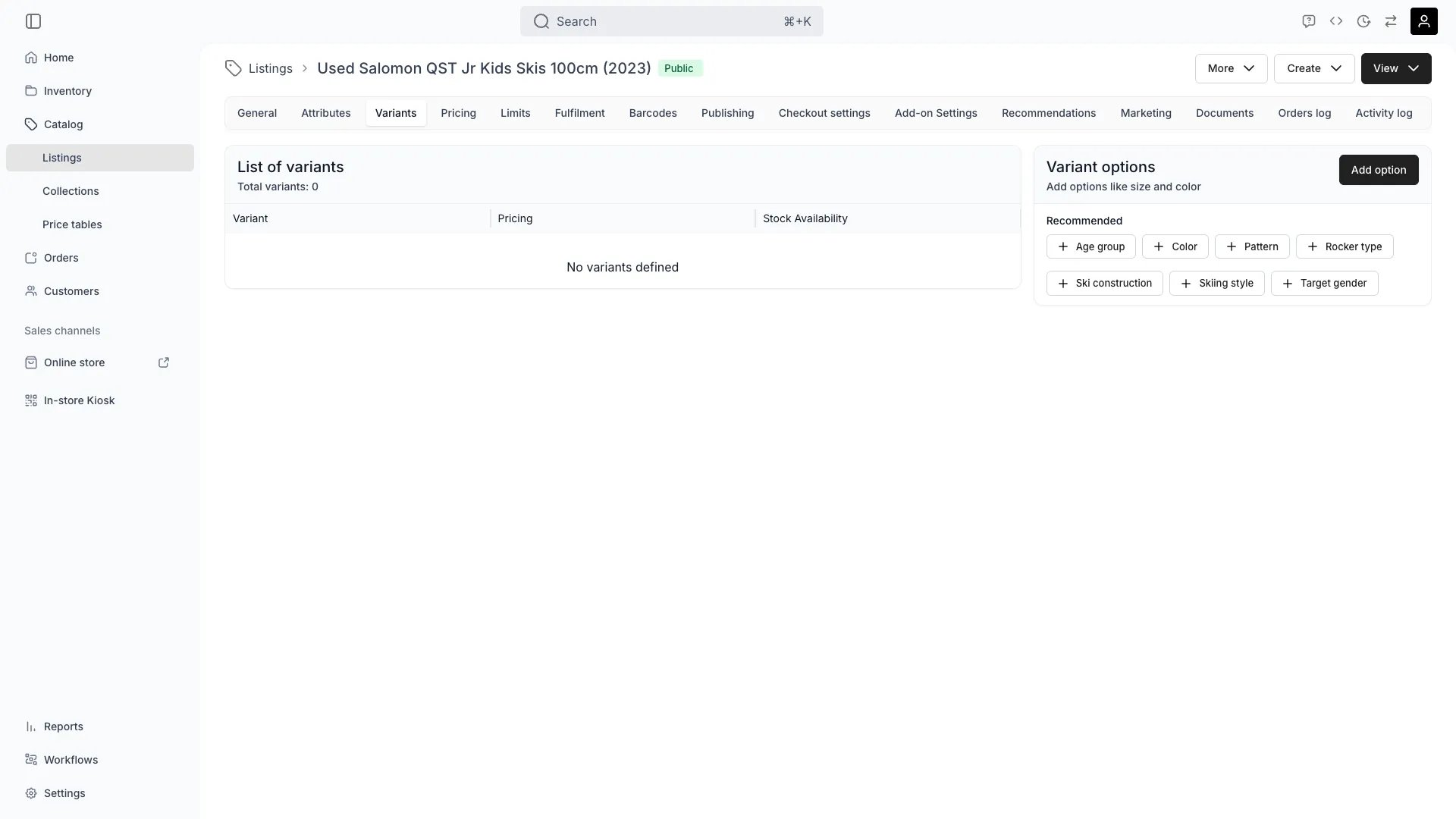
Why variants matter
Most listings have variations — like size, color, or material. Variants let you group those together under one product while still managing unique pricing, availability, or fulfillment rules per option. They give you granularity inside a single listing — for pricing, availability, and customer experience — while keeping your catalog clean and consistent.How variants are created
Variants are automatically suggested based on the category (taxonomy) you’ve assigned to your listing. For example, if the category is Apparel, TWICE Commerce might propose Size and Color as variant options. You can always define your own key–value pairs (like “Material: Linen” or “Edition: Limited”) for full control. Variants power:- More accurate pricing — define pricing rules for each variant (e.g. “XL” costs more)
- Smarter fulfillment — connect specific variant combinations to inventory articles under Fulfillment settings
- Cleaner listings — one listing, many options, no duplication
Variant options
Each variant option represents a dimension of choice — e.g. “Size” or “Color.” You can add, rename, or remove options as needed. TWICE Commerce uses the options you define to automatically generate all valid variant combinations. Example:
Results in 6 variants:
Small / Blue, Small / Black, Medium / Blue, etc.
Controlling hierarchy
Variant hierarchy defines how options are displayed and ordered — for example, “Color” first, then “Size.” The order you set here controls how variants appear both in your admin and your storefront.Fulfillment and inventory
Once variants are defined, you can connect them to inventory articles under Fulfillment settings. This allows real-time control of stock levels per variant (e.g. “Medium / Black” might be available in one store, but not another).Pricing per variant
In pricing settings, you can define variant-level prices and rules — for example:- Base price adjustments (“XL” +€5)
- Conditional pricing (different currencies, locations, or channels)