

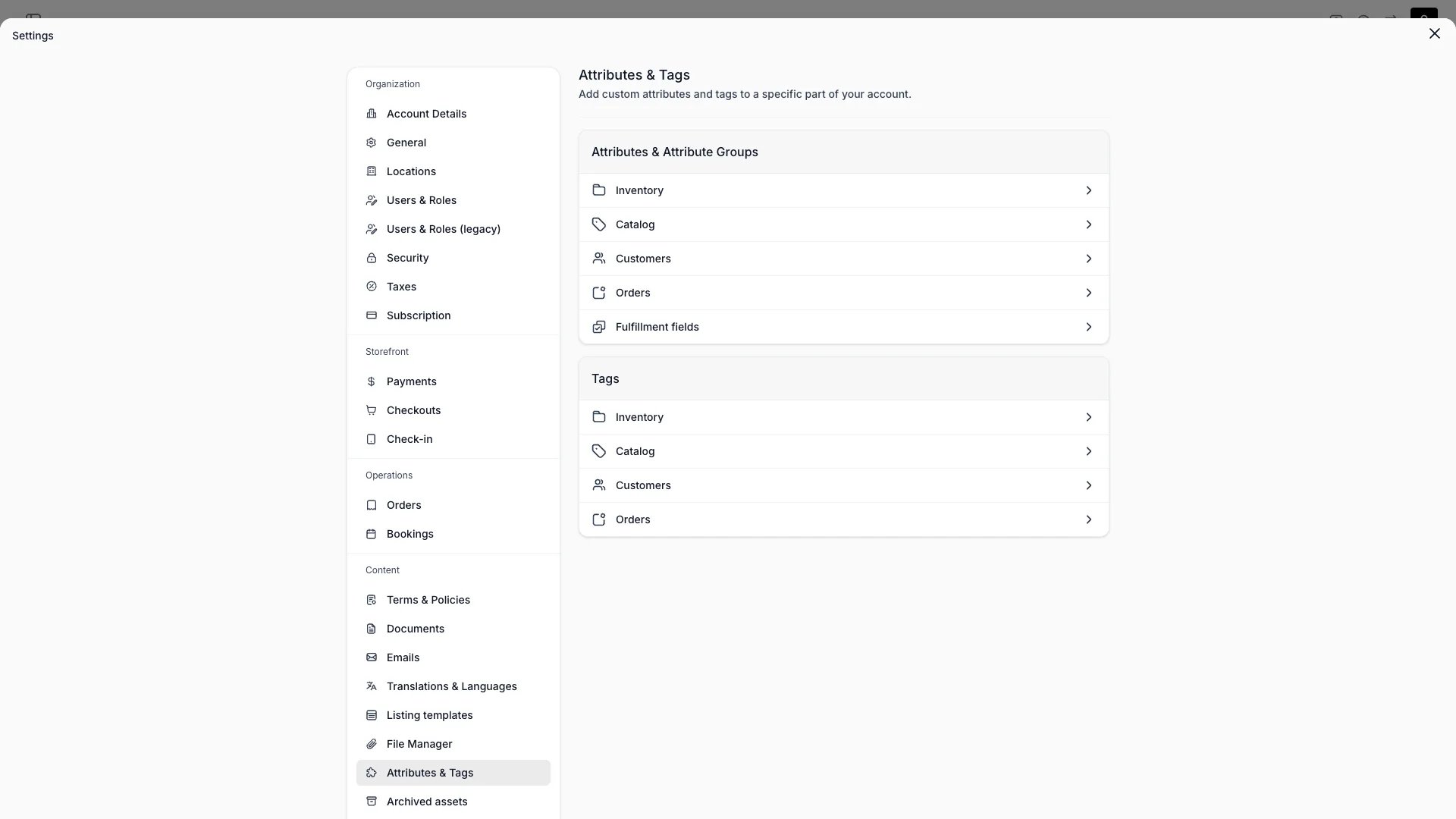
Settings > Attributes & Tags
Definition
is the hierarchical classification TWICE uses to describe what a product is. TWICE adopts the Shopify Product Taxonomy verbatim — every category, ID, and parent-child relationship matches the Shopify standard. Standardizing on Shopify’s taxonomy means your categorization is portable, reportable, and immediately compatible with marketplaces, ad platforms, and integrations that already speak the same language.How categories are structured
Each taxonomy category in TWICE carries:
Categories can be many levels deep. Leaf categories are the ones you typically assign to products — non-leaf categories exist for browsing the tree.
Where categories apply
In TWICE, a category can be assigned to:
Categories are assigned through the TaxonomyCategorySearch picker — start typing and the picker suggests matches based on the full hierarchical name. Vector-based search also surfaces close matches even when wording doesn’t match exactly.
Read more: SKUs · Listings
Categories vs. attributes vs. collections
Three concepts often get confused — here’s how they differ in TWICE:
Each layer answers a different question. Category answers “what kind of thing”; Attributes answer “what are its properties”; Collections answer “where do we want to promote it”.
Read more: Attributes · Collections
Category-linked attributes
Some categories in the Shopify taxonomy come with suggested attributes — for example, the “Bicycles” category suggestsFrame material, Wheel size, Brake type. TWICE stores these mappings (taxonomy_category_attributes) and uses them to:
- Prefill the attribute list on a SKU when you pick a category
- Suggest attribute values from the standardized value set (e.g. “Aluminum”, “Carbon”, “Steel” for Frame material)
- Power smart matching when bulk-importing products
Category-based reporting
Because every account uses the same category tree, reports group cleanly:- Sales by category — compare performance across product types without a custom mapping
- Inventory utilization by category — see which segments of the catalog drive rentals or sales
- Cross-account benchmarking — internal benchmarking across stores or regions stays apples-to-apples
Storefront navigation
Categories assigned to Listings flow through to your online store. Depending on the theme, this can drive:- Category browse pages — landing pages per category
- Faceted search — filter products by category or subcategory
- Breadcrumb navigation — surface the category hierarchy on Listing pages
- Sitemaps and structured data — SEO-friendly category metadata
API access
The taxonomy is read-only — you can browse and assign categories, but you can’t modify the tree itself. Query the taxonomy via the API: Useful query parameters:parentId, parentIds, level, isLeaf, ids.
Updates to the taxonomy
Shopify revises the Product Taxonomy periodically. TWICE imports updates so your categorization stays in sync with the upstream standard. When a category is renamed or restructured, the underlying ID remains stable so existing assignments don’t break.Relationships
FAQs
Why does TWICE use Shopify's taxonomy instead of letting me create custom categories?
Why does TWICE use Shopify's taxonomy instead of letting me create custom categories?
Standardization keeps your data portable. Reports compare cleanly across stores, integrations with Shopify or marketplaces don’t need a mapping layer, and your catalog is immediately legible to anyone who has worked with e-commerce. Custom categories would re-fragment all of that.
What if my product doesn't fit any category?
What if my product doesn't fit any category?
The Shopify taxonomy is broad — most product types resolve to a leaf within a few clicks. When nothing fits exactly, pick the closest broader category and use Attributes to express the specifics. If a whole class of products is missing, Shopify takes community proposals for new categories.
Can I assign multiple categories to one Listing?
Can I assign multiple categories to one Listing?
No — each entity (SKU or Listing) gets one category. Use Collections to group products across categories for marketing.
What's the relationship between a SKU's category and its Listing's category?
What's the relationship between a SKU's category and its Listing's category?
By default, a Listing inherits its category from the SKU. You can override the Listing’s category for storefront purposes without changing the SKU’s underlying classification.
Do category changes affect historical orders?
Do category changes affect historical orders?
No. Orders capture the category at the time of purchase. Changing a SKU’s category later updates current and future displays but doesn’t rewrite the order history.
Can categories drive workflow triggers?
Can categories drive workflow triggers?
Yes. Workflows can match on category — for example, automatically apply a “Needs annual service” task to all Stock Items in the Bicycles category. See Workflows.
Related articles
Attributes
Custom data fields that complement category classification
Collections
Marketing groups that span multiple categories
SKUs
Where the primary category assignment lives
Shopify Product Taxonomy
The upstream standard TWICE follows