

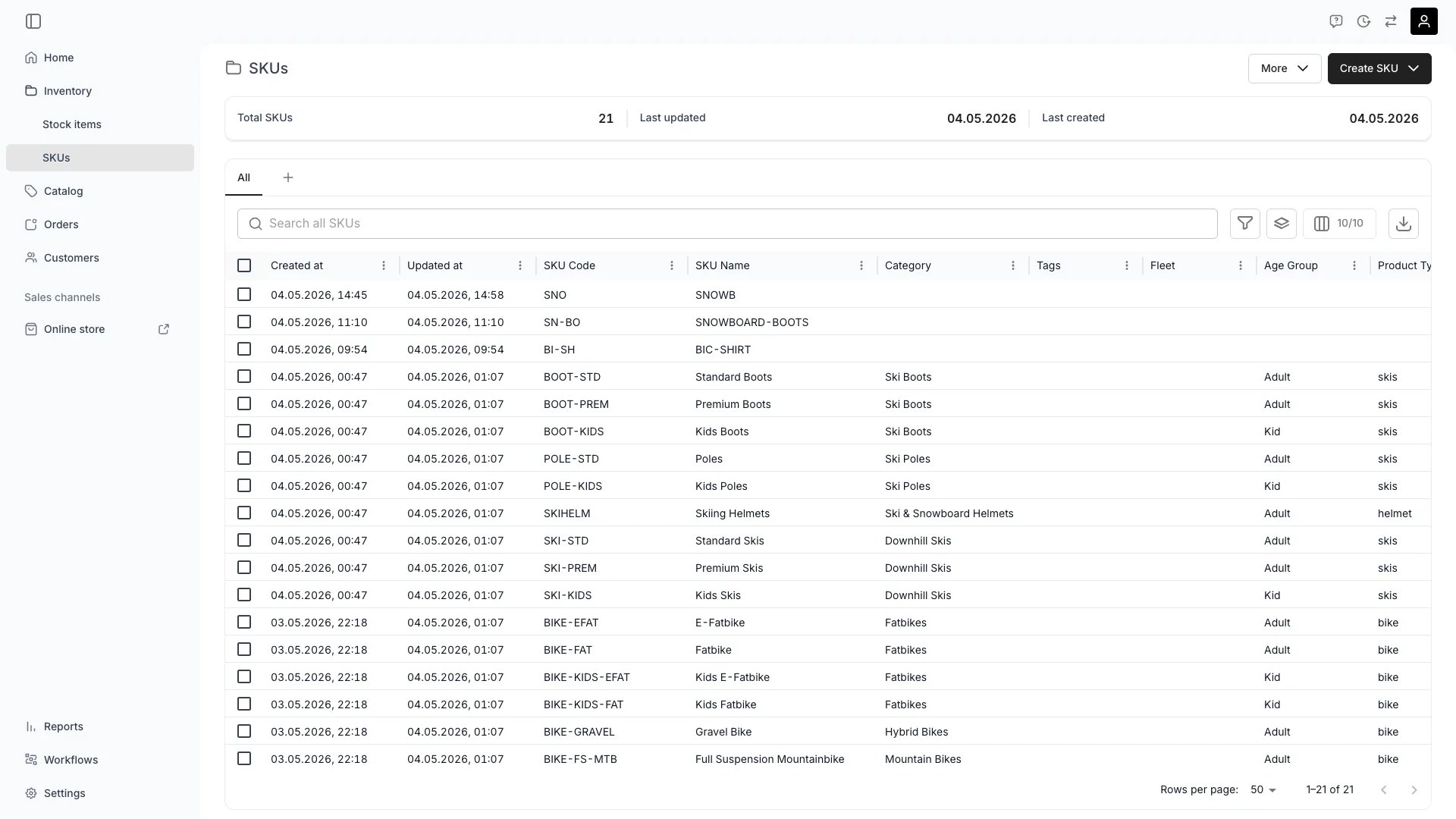
Inventory > SKUs
Definition
A SKU is a template for a product type. It holds product-level information — name, code, category, attributes, description, base purchase price — and acts as the parent definition for any number of Stock Items that represent the actual physical units.SKUs are templates. Define product information once on the SKU and every linked Stock Item inherits it. Stock Items can still override any inherited field individually — the SKU is a default, not a lock.
BIK-S named Bike S with:
- Category: Bicycles > City
- Attributes:
Brand: Trek,Frame size: S - Purchase price:
€499
€520 — override the purchasePrice on that one item; the rest still read €499 from the SKU.
Where do I use it?
SKUs are central to product management and appear throughout TWICE:- Product catalog management — define product templates that many Stock Items share
- Listing creation — Listings reference SKUs to define what is fulfillable
- Bulk operations — update pricing, description, or attributes once on the SKU and propagate to all linked items
- Reporting and analytics — analyse performance by product type rather than per item
- Inventory planning — track stock levels and demand patterns by SKU
- AI suggestions —
suggestSkuCodeproposes a code from the SKU name
SKU vs Stock Item
A Stock Item can also be unlinked (
skuId: null) — useful for one-off items that do not fit a product template.
Inherited fields
The following fields cascade from the SKU to every linked Stock Item:
Override behaviour:
- The Stock Item’s own value takes priority over the SKU’s value.
- The API exposes
*Originfields so you always know whether a value was inherited or set on the item. - Clearing a value on the Stock Item (set to
null) makes it re-inherit from the SKU. - Updating a SKU field instantly changes the effective value on every linked item that does not have its own override.
- Buffer time uses a three-state model:
null= inherit from SKU,0= explicit no buffer (overrides the SKU),> 0= custom override. See Stock Item Fulfillment for details.
SKU code
code is the user-facing identifier for the SKU. Rules:
- Required, minimum length 1.
- Must be unique within the tenant.
- Validate ahead of creation with
POST /skus/validate-codes. - Auto-suggest a code from a name with
POST /skus/suggest-code. - Editable after creation, but updates are checked against the same uniqueness rule.
BIK-S, SKI-ATOM-170, HELM-MD-RED. Choose something short, mnemonic, and stable.
Key Properties
Multi-listing per SKU
One SKU can power multiple Listings. The Listing layer adds rental terms, pricing tables, availability windows, channels — but the SKU underneath stays the same. This is how a single product can appear in different stores, packages, or pricing contexts without duplicating its identity.Relationships
Has many Stock Items
Has many Stock Items
Has many Stock Items via
articles[].skuId. Each Stock Item inherits SKU properties but maintains its own tracking, ledger, and event history.Referenced by Listings
Referenced by Listings
Listings reference SKUs as fulfillable stock sources. One SKU can power many Listings.
Belongs to a category and attributes
Belongs to a category and attributes
Belongs to a taxonomy category and has its own resource attributes. These cascade to linked Stock Items.
Lifecycle
1
Creation
SKUs are created when defining new product types in your catalog.
How do I create a SKU?
How do I create a SKU?
From Inventory → SKUs, click Create SKU. Provide a name; the code can be auto-suggested. You can also create SKUs automatically while registering Stock Items by typing a new SKU name into the SKU picker.
What information is required?
What information is required?
Minimum:
name and code. Recommended: taxonomyCategoryId, purchasePrice, description, and attributes — anything you want inherited by every Stock Item.Can creation be automated?
Can creation be automated?
Yes. Use
POST /skus (single) or POST /skus/many (bulk). Both are idempotent on code — duplicate codes are rejected up front by validateCodes.2
Usage
Active SKUs act as templates across operations.
Where do I see SKUs?
Where do I see SKUs?
Inventory → SKUs, the SKU detail page (with embedded Stock Items), Stock Item registration, Listing configuration, and reporting.
What actions can I perform?
What actions can I perform?
Edit any field, link Stock Items by setting their
skuId, attach tags, configure attributes, and manage taxonomy. SKU-level updates propagate immediately to linked Stock Items that have not overridden the field.Does a SKU have status?
Does a SKU have status?
Not directly. Availability is determined by linked Stock Items. A SKU with no
active Stock Items has zero ATS.3
Modification
Use SKUs to make bulk changes.
How do I edit a SKU?
How do I edit a SKU?
Open the SKU detail and edit, or use
PATCH /skus/:skuId. Changes propagate to linked Stock Items via inheritance.What about the SKU code?
What about the SKU code?
Editable, but the new value must be unique within the tenant. Avoid changing codes that are printed on physical labels.
Can I bulk update attributes?
Can I bulk update attributes?
Yes. Updating attributes on the SKU updates the effective value on every linked Stock Item that has not overridden that attribute.
4
Deletion
SKUs can be deleted when discontinued.
How do I delete a SKU?
How do I delete a SKU?
From the SKUs table or
DELETE /skus/:skuId. To delete many at once: POST /skus/delete with either { ids } or { deleteAllExcept }.What happens to linked Stock Items?
What happens to linked Stock Items?
Their
skuId becomes null (they become unlinked). Inherited values are lost on next read — set them directly on the items if you need to keep them.FAQs
Should I create the SKU before or after the Stock Items?
Should I create the SKU before or after the Stock Items?
Either works. Create SKUs first when planning a catalog. For ad-hoc inventory, the Stock Item registration flow will create or link a SKU on the fly.
Can a Stock Item belong to more than one SKU?
Can a Stock Item belong to more than one SKU?
No.
skuId is single-valued. You can switch the link any time (recorded as a sku_changed event), but only one is active at a time.How do SKU attributes differ from Stock Item attributes?
How do SKU attributes differ from Stock Item attributes?
Same shape, different scope. SKU attributes describe the product type (e.g.
Brand: Trek). Stock Item attributes can add or override per-unit values (e.g. a specific item with Frame number: ABC123). On the API, item-level values win.Do I need a SKU at all?
Do I need a SKU at all?
No —
skuId is nullable. For one-off items, register a Stock Item without a SKU. You lose inheritance and cross-item rollups, but the item still has its own ledger, events, and lifecycle.Can I move all items from SKU A to SKU B?
Can I move all items from SKU A to SKU B?
Yes — update each Stock Item’s
skuId (single bulk update or scripted via the API). The SKU code on each item is rewritten to the new SKU; ledger and event history follow the item.Developer Reference
SKUs are exposed asskus in the API.
API: SKUs
Open the endpoint in the API reference.
Related articles
Stock Items
Individual physical units that link to a SKU
Inventory Tracking
Serialized vs pooled — set on Stock Items, not on SKUs
Stock Codes
Codes on Stock Items vs SKU code