

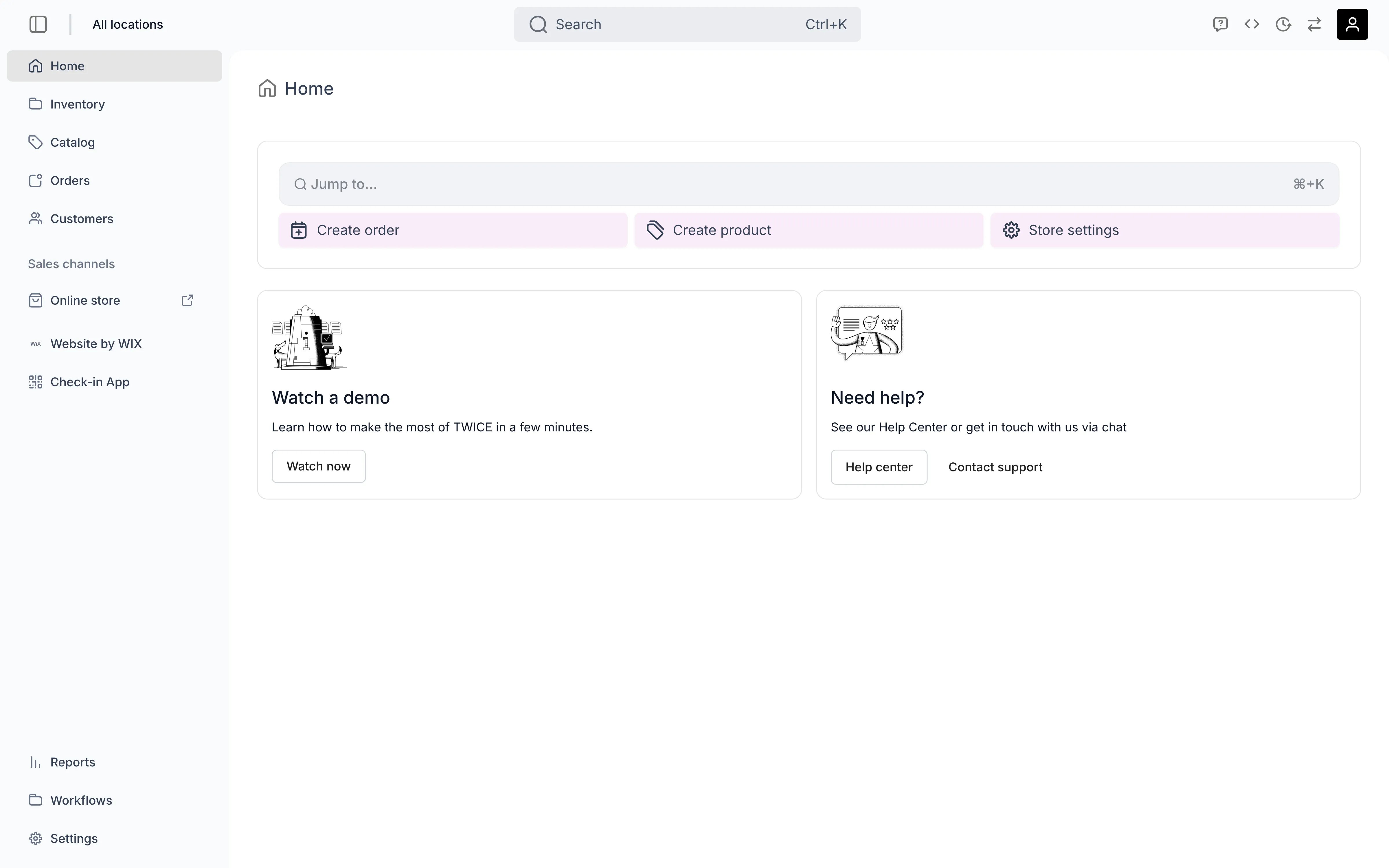
TWICE Admin Sidebar
This view can look different dependent on your user role.
See Visibility and permissions for details.
See Visibility and permissions for details.
Primary purpose
The sidebar is divided into three main sections for efficient navigation:- Location-specific navigation — At the top, you’ll find access to features that apply to your selected location(s): Home, Inventory, Catalog, Orders, and Customers. These sections change context based on your location selection.
- Sales Channels — This section provides shortcuts to manage your sales channels (like Online Store) that are global to your account, giving you visibility beyond a single location.
- Account-level navigation — The final section contains account-wide features such as Reports, Workflows, and Settings that impact your overall TWICE Commerce environment.
Location-Specific Navigation
Home
Home
Access the dashboard showing key metrics, recent activity, and quick actions to start your day.Read more: Home Dashboard
Inventory
Inventory
View and manage all at your selected location. Add new stock items, update details or quantities, and organize related items using .Check availability, create for maintenance or internal orders, and enrich your data using custom for filtering and reporting.Read more: Inventory ManagementRelated guides: Register New Stock • Track Item Costs
Catalog
Catalog
Build and manage your product , , and pricing.This defines what your customers see and can purchase in each and .Read more: Catalog Management
Orders
Orders
Create and manage for the selected .You can them for any .Read more: Order ManagementRelated guides: Creating an Order
Customers
Customers
Manage customer profiles, track transaction history, and build relationships with your customer base.Read more: Customer Management
Tasks (coming soon)
Tasks (coming soon)
Organize and track work across your team with assignments, due dates, and progress monitoring.Not available yet. There is no committed release date.
Sales Channels
Online Store
Online Store
Configure and manage your — a whitelabel storefront provided by TWICE to reach customers and handle e-commerce transactions directly under your own branding.Read more: Online Store
Other Sales Channels
Other Sales Channels
All additional and third-party sales channels (apps and integrations) will be listed here for centralized management.Read more: Managing Sales Channels
Account-Level Navigation
Reports
Reports
Create, view, and manage custom reports tailored to your business needs. Build your own reports for sales, rentals, inventory, and accounting — or start from template examples to track performance and ensure financial compliance.Read more: Reports
Workflows
Workflows
Build automated workflows that trigger actions based on events, saving time and ensuring consistency across operations.Read more: Workflows
Settings
Settings
Configure account-wide settings, integrations, payment providers, and system preferences.Read more: Settings
Related concepts
Here are a few key concepts of TWICE Commerce that relate to the sidebar navigation.Section Organization
Section Organization
The sidebar mirrors your commerce operations, organizing functionality into logical sections:
- Core Assets (Inventory, Catalog, Orders, Customers) for day-to-day operations
- Sales Channels for customer-facing interfaces
- Operations & Analysis (Reports, Workflows) for automation and analysis.
- Configuration (Settings) for system setup
Personalized for You
Personalized for You
You see every section except the ones your roles hide. Hiding is set per role on its UI Visibility tab, and it is a separate choice from data access: restricting what a role may read leaves its sidebar alone, and a page it cannot read opens empty.Read more: UI visibility | Users & Roles
Location Context
Location Context
While the sidebar structure remains consistent, the data you see within each section is filtered by your selected location (set in the top navigation). This ensures you’re always working with the relevant inventory, orders, and customers for your current context.Read more: Locations