

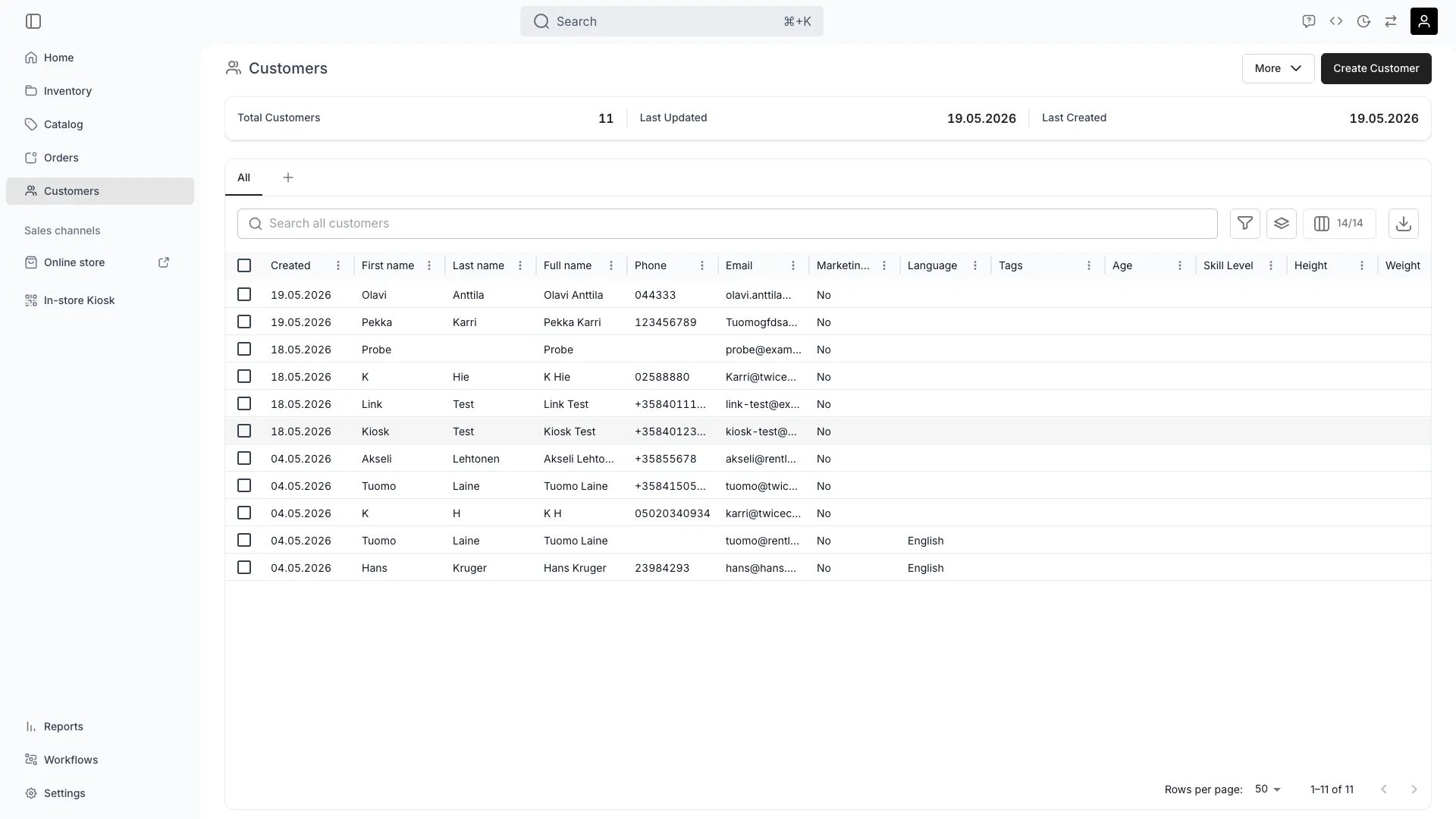
Customers
Open in TWICE Admin
customers
Prerequisites
Before you start:
- Know your legal basis for emailing. Marketing consent is a field on every profile. Exporting people who have not consented and mailing them anyway is your risk, not TWICE’s.
- Know what your email tool needs. Most want an email column plus a name; some want a language or a country for localisation.
The walkthrough
1
Filter on marketing consent first
Set the Marketing consent filter to true, and make it the first filter rather than the last check. A list built the other way round is one accidental send away from a problem.
2
Narrow to the segment you want
Add the filters that define the segment: a tag, an attribute, a language, a Created period, or a combination. Segment customers covers the mechanics.
3
Set the columns you want in the file
Choose the columns you need, hide the rest, and reorder them to match what your email tool expects on import. The export contains the visible columns, in the order they are shown, so shaping the file is column work rather than export work.A workable set for most mail platforms:
4
Leave out what you do not need
Leave out every column the campaign does not use. An export carrying dates of birth and addresses to a mail tool is personal data you have moved for no reason.
5
Export the view
Export with the button on the table. The file mirrors the view, since all filters, sorts, groupings and visible columns are respected, which is why the previous two steps are the actual work.See Tables for the export control and the rest of the table features.
6
Check the file before you upload it
Check four things in the file. Two minutes here saves a bad send:
- Row count. Does it match what the table said? A surprise means a filter did not apply the way you thought.
- Consent column. Every row true, if you filtered on it.
- Encoding. Accented names should look right, since a mail tool that mis-reads the encoding will greet people with mojibake.
- No blank emails. A row without an address is a row your tool will reject.
7
Repeat rather than sync
Export again on a rhythm that matches how often you send. The export is a snapshot and there is no ongoing sync, so a list in your email tool starts drifting from TWICE the moment you upload it. New customers do not appear, and customers who withdraw consent in TWICE stay subscribed in your tool.Use your tool’s own suppression list as the second line of defence, and treat withdrawal as a two-place job: someone unsubscribing needs their consent cleared in TWICE and removing in the tool, or the next export re-adds them.Save the view for a segment you use constantly, so each re-export is one click rather than a rebuild.
How do I know it worked?
- The file opens with the columns you chose, in that order, and the row count matches the table.
- Every row has an email, and every row is consented.
- Your email tool accepts the import without a column-mapping fight.
- The saved view is on the tab row, so the next export is a click.
Troubleshooting / common pitfalls
The export has columns I did not want
The export has columns I did not want
The export takes the visible columns rather than offering a separate field picker.Choose the columns first, then export. Reordering them also reorders the file, which is worth doing if your tool imports by position.
The list is bigger than the number of people I can email
The list is bigger than the number of people I can email
You almost certainly did not filter on Marketing consent. The table shows every customer, and only some have consented.Add the filter and re-export. Do not fix this on the email tool’s side, because the authoritative flag is in TWICE and next month’s export will have the same problem.
Someone unsubscribed in our email tool and got the next campaign anyway
Someone unsubscribed in our email tool and got the next campaign anyway
The export re-added them. Unsubscribing in the tool does not reach back into TWICE, so the flag there still says consented.Turn off Marketing consent on the profile as well. Any unsubscribe process that does not write back to TWICE will keep producing this.
Accented characters are mangled after import
Accented characters are mangled after import
The encoding of the file and of your email tool’s import do not match, and the data itself is fine.Check the file opens correctly first, then set the encoding explicitly during your tool’s import step rather than accepting its default.
Related articles
Segment customers
Building the view before you export it.
Export or erase a customer's data
The single-customer, privacy-request version.
Tables
The export control and column features.
Webhooks
Building a real sync instead of exporting.