> ## Documentation Index
> Fetch the complete documentation index at: https://www.twicecommerce.com/docs/llms.txt
> Use this file to discover all available pages before exploring further.
# Stock Item vs SKU
> Understand the difference between individual stock items and SKU templates, and when to use each
export const skuDefinition = "A SKU (Stock Keeping Unit) is a product-level identifier that groups similar stock items under a shared definition. SKUs enable you to manage product information, pricing, and attributes at scale while maintaining individual stock item tracking for serialized inventory management.";
export const stockItemDefinition = "A Stock Item is a unique, serialized inventory record in TWICE that represents either a single physical item or a group of identical items tracked together. Each stock item has its own item code, allowing precise tracking of usage, income, expenses, and lifecycle events throughout its entire journey in your business.";
export const viewAccessDefinition = "Read-only access without ability to make changes.";
export const editAccessDefinition = "Update and read data, but cannot create or delete.";
export const manageAccessDefinition = "Create, update, read, and delete data.";
export const permissionsDefinition = "The actions you are authorized to perform.";
export const visibilityDefinition = "Which features, sections, or data tables are visible to you.";
export const userRoleDefinition = "What a user can see and do. Each user has one built-in system role — Owner, Admin, Manager, or Member — and can also be assigned any number of custom roles you create with specific permissions. Effective access is the combination of all their roles.";
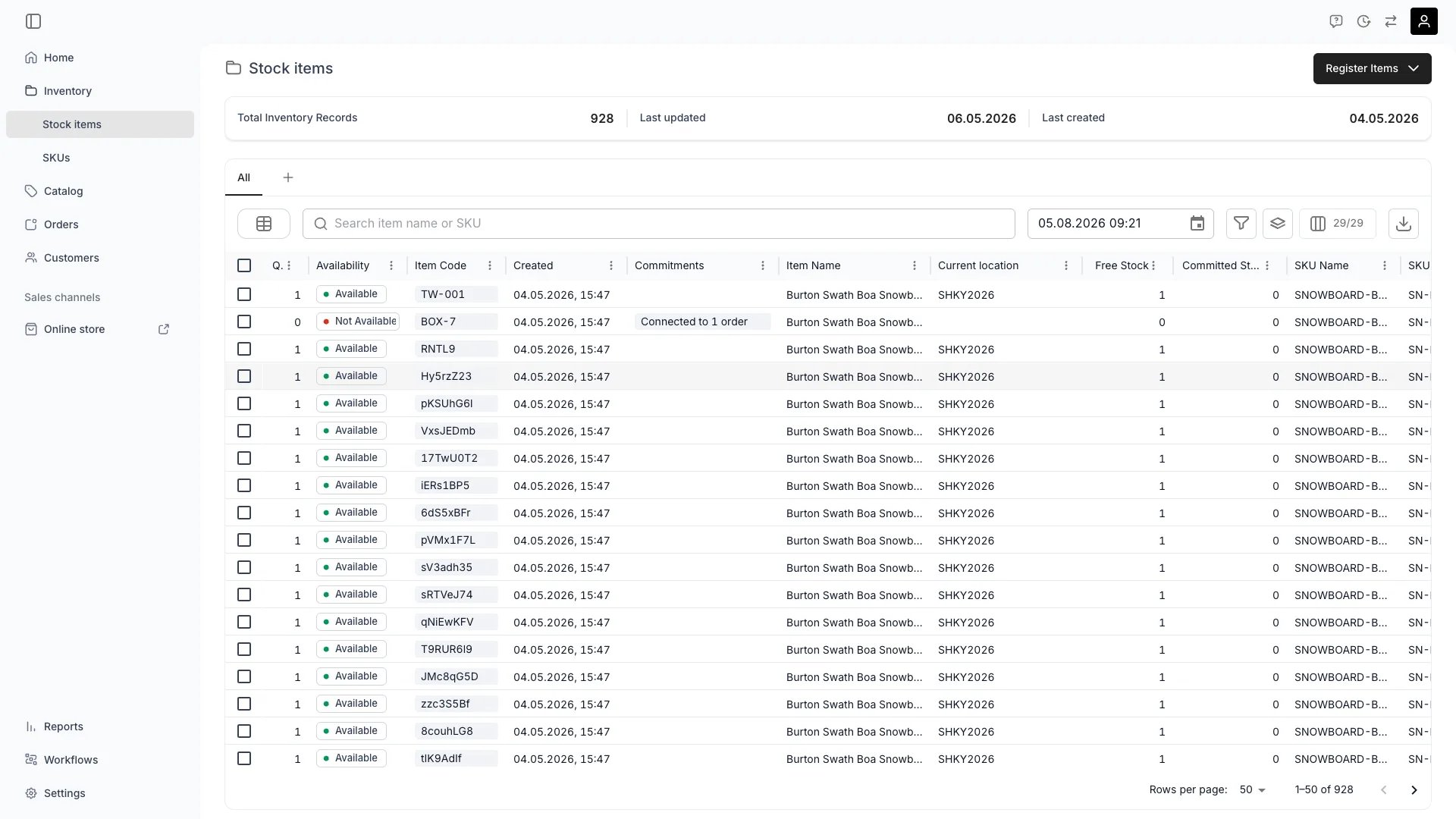 TWICE Commerce uses two interconnected but distinct concepts for inventory management: **Stock Items** and **SKUs**. Understanding their relationship is essential for effective inventory management.
## Quick Comparison
| Aspect | Stock Item | SKU |
| ---------------------- | --------------------------------- | -------------------------------- |
| **What it represents** | Individual physical unit | Product template/grouping |
| **Tracking level** | Each item tracked uniquely | Groups similar items |
| **Quantity** | Always represents 1 or more units | Can have many stock items |
| **Attributes** | Can have unique attributes | Defines shared attributes |
| **Financial data** | Individual income & expenses | Aggregated income & expenses |
| **Timeline** | Individual item events | Aggregated events from all items |
| **Use case** | High-value, serialized tracking | Streamlining data entry |
## Stock Items
Stock Items are the foundation of TWICE's serialized inventory approach. Each stock item represents an individual physical unit that you track through its entire lifecycle.
### When to Use Stock Items
Track items individually when you need to know the specific history, condition, income, and expenses of each unit—essential for rental equipment, luxury goods, or assets.
When every unit is different (e.g., vintage clothing, used electronics, consignment items), each should be its own stock item.
Stock items maintain complete timelines, activity logs, and financial records for accountability and compliance.
### Stock Item Views
Navigate to **Inventory > Stock Items** to access:
Define identity, quantity, category, attributes, location, status, and media
Track individual item profitability with detailed income and expense records
Configure checkout questions, service requirements, and preparation rules
Attach manuals, warranties, inspection reports, and certificates
View past, present, and future events (orders, maintenance, transfers)
Complete audit trail of all changes and actions
## SKUs (Stock Keeping Units)
SKUs act as templates or wrappers that group similar stock items under a shared product definition. They streamline inventory management by defining information once and applying it to many items.
### When to Use SKUs
When you have multiple identical or similar items (e.g., 20 mountain bikes of the same model), create one SKU and link all items to it.
Define attributes, categories, and settings at the SKU level—all linked stock items inherit them automatically, eliminating repetitive data entry.
Read more: How to Use SKUs to Streamline Inventory
View aggregated financial data, timelines, and documents across all items of a product type for performance analysis.
Link SKUs to catalog listings to ensure inventory availability flows correctly to your storefront.
### SKU Views
Navigate to **Inventory > SKUs** to access:
Define SKU identity, default settings, and basic product information
Shared attributes inherited by all linked stock items
View and manage every stock item linked to this SKU
Manage shared documents that apply to all items (manuals, specifications)
Audit trail of SKU changes and aggregated item activities
## The Relationship
```mermaid theme={null}
%%{init: {'flowchart': {'nodeSpacing': 20, 'rankSpacing': 40}}}%%
flowchart TB
SKU["**SKU: Mountain Bike - Large**
TWICE Commerce uses two interconnected but distinct concepts for inventory management: **Stock Items** and **SKUs**. Understanding their relationship is essential for effective inventory management.
## Quick Comparison
| Aspect | Stock Item | SKU |
| ---------------------- | --------------------------------- | -------------------------------- |
| **What it represents** | Individual physical unit | Product template/grouping |
| **Tracking level** | Each item tracked uniquely | Groups similar items |
| **Quantity** | Always represents 1 or more units | Can have many stock items |
| **Attributes** | Can have unique attributes | Defines shared attributes |
| **Financial data** | Individual income & expenses | Aggregated income & expenses |
| **Timeline** | Individual item events | Aggregated events from all items |
| **Use case** | High-value, serialized tracking | Streamlining data entry |
## Stock Items
Stock Items are the foundation of TWICE's serialized inventory approach. Each stock item represents an individual physical unit that you track through its entire lifecycle.
### When to Use Stock Items
Track items individually when you need to know the specific history, condition, income, and expenses of each unit—essential for rental equipment, luxury goods, or assets.
When every unit is different (e.g., vintage clothing, used electronics, consignment items), each should be its own stock item.
Stock items maintain complete timelines, activity logs, and financial records for accountability and compliance.
### Stock Item Views
Navigate to **Inventory > Stock Items** to access:
Define identity, quantity, category, attributes, location, status, and media
Track individual item profitability with detailed income and expense records
Configure checkout questions, service requirements, and preparation rules
Attach manuals, warranties, inspection reports, and certificates
View past, present, and future events (orders, maintenance, transfers)
Complete audit trail of all changes and actions
## SKUs (Stock Keeping Units)
SKUs act as templates or wrappers that group similar stock items under a shared product definition. They streamline inventory management by defining information once and applying it to many items.
### When to Use SKUs
When you have multiple identical or similar items (e.g., 20 mountain bikes of the same model), create one SKU and link all items to it.
Define attributes, categories, and settings at the SKU level—all linked stock items inherit them automatically, eliminating repetitive data entry.
Read more: How to Use SKUs to Streamline Inventory
View aggregated financial data, timelines, and documents across all items of a product type for performance analysis.
Link SKUs to catalog listings to ensure inventory availability flows correctly to your storefront.
### SKU Views
Navigate to **Inventory > SKUs** to access:
Define SKU identity, default settings, and basic product information
Shared attributes inherited by all linked stock items
View and manage every stock item linked to this SKU
Manage shared documents that apply to all items (manuals, specifications)
Audit trail of SKU changes and aggregated item activities
## The Relationship
```mermaid theme={null}
%%{init: {'flowchart': {'nodeSpacing': 20, 'rankSpacing': 40}}}%%
flowchart TB
SKU["**SKU: Mountain Bike - Large**
Attributes: Brand, Type, Size
Category: Sports Equipment"]
Item1["Stock Item #1
Serial: MB-001
Inherits SKU attributes"]
Item2["Stock Item #2
Serial: MB-002
Inherits SKU attributes"]
Item3["Stock Item #3
Serial: MB-003
Inherits SKU attributes"]
SKU -->|groups| Item1
SKU -->|groups| Item2
SKU -->|groups| Item3
style SKU fill:#3b82f633,stroke:#3b82f6,stroke-width:3px,font-weight:bold
style Item1 fill:#10b98133,stroke:#10b981,stroke-width:2px
style Item2 fill:#10b98133,stroke:#10b981,stroke-width:2px
style Item3 fill:#10b98133,stroke:#10b981,stroke-width:2px
```
### How They Work Together
Define attributes on the SKU (e.g., "Brand: Atomic", "Type: Ski", "Size: Large"), and all linked stock items automatically inherit them. Update the SKU once, and all items reflect the change.
Even though stock items share a SKU, each maintains its own:
* Unique item code and identity
* Individual usage history and timeline
* Separate income and expense records
* Distinct condition and status
* Own location and availability
The SKU provides consolidated views:
* Total income and expenses across all items
* Combined timeline of all events
* Aggregated documents and activity logs
* Product-level performance metrics
Each stock item can belong to one SKU at a time, maintaining a clear and traceable data structure.
## Common Scenarios
**Scenario**: You rent out 50 identical tents.
**Approach**: Create one SKU "2-Person Tent" with shared attributes (brand, capacity, weight). Create 50 stock items, each representing a physical tent with its own serial number. Each tent's rental history, maintenance, and condition are tracked individually, while the SKU provides fleet-level insights.
**Scenario**: Every item is unique with different brands, conditions, and prices.
**Approach**: Use stock items for individual tracking. SKUs are optional but can still be useful for grouping (e.g., "Men's Jackets" SKU with each jacket as a unique stock item having different sizes, brands, and conditions).
**Scenario**: Some items are serialized (high-value bikes), others are pooled (bike helmets).
**Approach**: High-value bikes get individual stock items linked to a "Mountain Bike" SKU. For helmets, create one stock item with quantity > 1 for pooled tracking, linked to a "Bike Helmet" SKU.
Read more: [Inventory Tracking](/docs/concepts/inventory/inventory-tracking)
**Scenario**: You want to display products on your online store with real-time availability.
**Approach**: Create SKUs for each product type and link them to catalog listings. As stock items get booked or sold, availability automatically updates on your storefront.
## Key Takeaways
Use stock items for individual, serialized tracking of physical units—each with its own lifecycle, financial records, and history.
Use SKUs as templates to group similar items, streamline data entry, and get product-level insights.
SKUs define shared information; stock items inherit it while maintaining individual tracking. This combination provides both efficiency and granularity.
You can always create SKUs later to group items. Start by registering individual stock items, then organize them with SKUs as your inventory grows.
## Visibility and Permissions
Access to both Stock Items and SKUs is controlled by your user role. Your user role determines both
visibility and
permissions for
manage,
edit, and
view access levels.
| Feature | Admin | Manager | Member |
| ----------------- | ----- | ------- | ------ |
| Stock Items Table | ✓ | ✓ | ✓ |
| SKUs Table | ✓ | ✓ | ✓ |
| Create/Edit Items | ✓ | ✓ | ✗ |
| Create/Edit SKUs | ✓ | ✓ | ✗ |
| Financial Data | ✓ | ✓ | ✓ |
| Activity Logs | ✓ | ✓ | ✓ |
| Resource | Admin | Manager | Member |
| ----------------- | ------ | ------- | ------ |
| Stock Items | Manage | Edit | View |
| SKUs | Manage | Edit | View |
| Attributes | Manage | Edit | View |
| Financial Records | Manage | View | View |
## Related Concepts
Learn about serialized vs. pooled inventory tracking methods
Understand unique identifiers for stock items and their aggregation
Understand how to control operational availability of stock items
Learn about automatic IN/OUT tracking for physical availability