> ## Documentation Index
> Fetch the complete documentation index at: https://www.twicecommerce.com/docs/llms.txt
> Use this file to discover all available pages before exploring further.
# How to import customers from a CSV
> Bring an existing customer list into TWICE — the columns the importer accepts, why every row creates a new profile rather than updating one, and what it will not carry across.
 customers
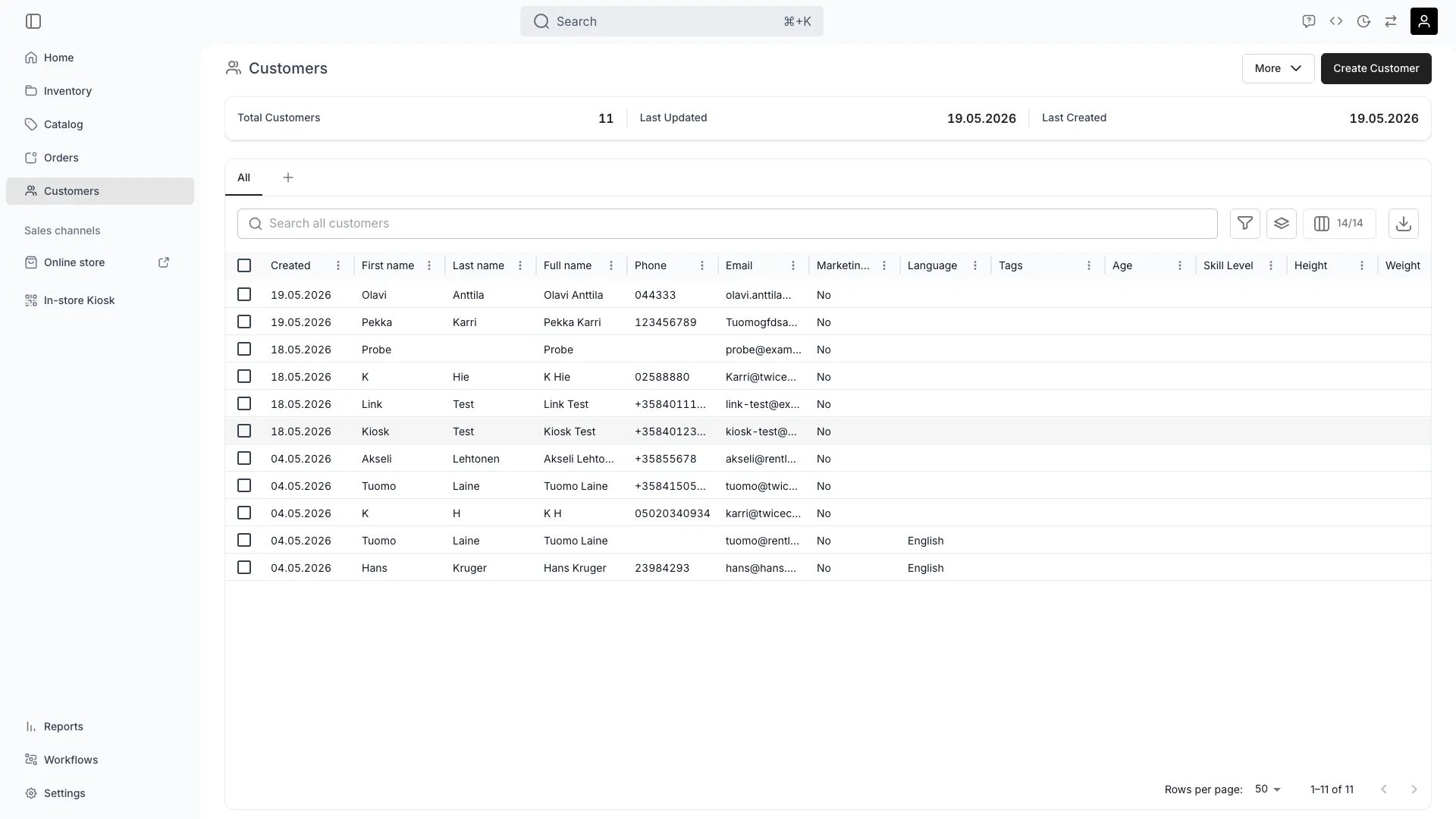
Moving to TWICE usually means bringing a customer list with you. The importer takes a CSV and makes profiles from it, which is most of the job — but it is narrower than the profile itself, and it only ever creates.
Knowing both limits before you start saves the two expensive mistakes: assuming a re-import will update what is already there, and assuming everything on your old records comes across.
## Prerequisites
**Required permissions:** `customers:customer` in create. All four system roles hold it. See [Users & Roles](/docs/settings/users-roles).
**Have ready before you start:**
* **A CSV with a header row.** The importer matches your column names against the ones it expects, and recognises common variants (`first name`, `firstname`, `first_name`).
* **A first name and a unique email on every row.** These are the two required columns, and a row missing either cannot be imported.
* **A deduplicated file.** Two rows sharing an email fail each other — see the pitfalls.
## The Walkthrough
Six columns, and that is the whole list:
| Column | Required | Notes |
| --------------------- | -------- | ---------------------------------------------------------------- |
| **First name** | Yes | *First name is required* if blank |
| **Last name** | No | |
| **Email** | Yes | Must be unique in the file *and* against your existing customers |
| **Phone number** | No | |
| **Marketing consent** | No | Defaults to `false` when blank — see the note below |
| **Language** | No | Defaults to `en` when blank |
Anything else in your file is ignored. In particular the importer does **not** carry **Customer type**, **Company name**, **Tax / VAT ID**, addresses, tags, or custom attributes — so a B2B list arrives as a set of individuals with no company details, and everything imported has an empty **Billing address**.
**Marketing consent defaults to `false`, and that is the safe default — leave it alone unless your old system recorded real consent.** Setting the column to `true` wholesale because it is convenient asserts a consent you may not have. The flag is what your email exports filter on, so it should be true only where it is true.
Open **Import customers** from the customers table and follow the steps: upload the file, map your columns onto the expected ones, and review what the importer flags before committing.
Column mapping is where a differently-named header gets pointed at the right field. The importer pre-matches obvious variants, so usually you are confirming rather than mapping.
Validation runs per row, and the email check runs twice — once inside your file and once against your existing customers. Three messages you will actually see:
| Message | Meaning |
| ------------------------------------------- | --------------------------------------------------- |
| *First name is required* | The row has no first name |
| *Email must be unique* | Two or more rows in **this file** share the address |
| *Email already exists for another customer* | The address is already on a profile in TWICE |
Fix the file and re-upload rather than committing a partial set. A row that fails validation is not imported, and there is no report afterwards telling you which ones did not make it.
**The importer creates profiles. It never matches or updates an existing one.**
That is why an existing email is an error rather than a merge: a row for a customer TWICE already knows is rejected, not applied on top. So:
* **You cannot use import to bulk-update customers.** Re-importing a corrected file does not fix the records already in TWICE; it fails on every row that matched.
* **You cannot import in passes** — one file with names, another adding phone numbers. The second pass fails entirely.
* **Get the file right before the first run.** It is the only run that lands.
To change many existing customers, edit them in the table instead.
After the import, the profiles exist but are thin. Depending on your operation, some of this matters:
* **Business customers** need **Customer type**, **Company name** and **Tax / VAT ID** set — see [Set up business customers](/docs/guides/customers/business-customers).
* **Addresses** are empty and have to be added where you invoice or deliver.
* **Tags and attributes** are unset, so any segmentation you had is gone. Rebuild it — see [Segment customers](/docs/guides/customers/segment-customers).
Prioritise by what you will actually use. A list you only email needs email and consent to be right and nothing else.
## How do I know it worked?
* **The customers table row count** matches your file, less any rows you knowingly dropped.
* **A sample of records reads correctly** — spot-check a few, especially any with accented characters or unusual phone formats.
* **Marketing consent is true only where it should be**, which is worth filtering the table to check before you send anything.
* **Language is right**, since it decides which language each customer's emails render in.
## Troubleshooting / Common Pitfalls
**Cause:** that address is already on a profile. The importer creates only, so it treats a known email as a collision rather than an update.
**What to do:** remove those rows from the file. If the existing record needs the file's data instead, edit it directly — import will not do it.
**Cause:** the duplicate is *within your file*. Two rows share the address, so both fail.
**What to do:** deduplicate before uploading. Exports from older systems frequently contain the same person twice under different names.
**Expected — import cannot update.** Every row matching an existing email was rejected, and any that succeeded created a *second* profile.
**What to do:** check for duplicates you may just have created, then correct the originals in the table instead.
**Expected.** **Customer type**, **Company name** and **Tax / VAT ID** are not importable columns, so a B2B list arrives as individuals.
**What to do:** set them per profile, or accept individuals if you do not invoice companies. There is no bulk route for this.
**Not possible** — email is required and must be unique, because it is the identity the record is found and contacted by.
**What to do:** for a customer you genuinely have no email for, create the profile by hand rather than trying to force the file through.
**The importer batches it** — rows are sent in chunks rather than one request, so size alone is not a problem. Give it time and do not close the dialog mid-run.
## Next Steps
Rebuilding groups and attributes the import did not carry.
Adding the company details after an import.
Getting the list back out again.
The table, its columns and its filters.
customers
Moving to TWICE usually means bringing a customer list with you. The importer takes a CSV and makes profiles from it, which is most of the job — but it is narrower than the profile itself, and it only ever creates.
Knowing both limits before you start saves the two expensive mistakes: assuming a re-import will update what is already there, and assuming everything on your old records comes across.
## Prerequisites
**Required permissions:** `customers:customer` in create. All four system roles hold it. See [Users & Roles](/docs/settings/users-roles).
**Have ready before you start:**
* **A CSV with a header row.** The importer matches your column names against the ones it expects, and recognises common variants (`first name`, `firstname`, `first_name`).
* **A first name and a unique email on every row.** These are the two required columns, and a row missing either cannot be imported.
* **A deduplicated file.** Two rows sharing an email fail each other — see the pitfalls.
## The Walkthrough
Six columns, and that is the whole list:
| Column | Required | Notes |
| --------------------- | -------- | ---------------------------------------------------------------- |
| **First name** | Yes | *First name is required* if blank |
| **Last name** | No | |
| **Email** | Yes | Must be unique in the file *and* against your existing customers |
| **Phone number** | No | |
| **Marketing consent** | No | Defaults to `false` when blank — see the note below |
| **Language** | No | Defaults to `en` when blank |
Anything else in your file is ignored. In particular the importer does **not** carry **Customer type**, **Company name**, **Tax / VAT ID**, addresses, tags, or custom attributes — so a B2B list arrives as a set of individuals with no company details, and everything imported has an empty **Billing address**.
**Marketing consent defaults to `false`, and that is the safe default — leave it alone unless your old system recorded real consent.** Setting the column to `true` wholesale because it is convenient asserts a consent you may not have. The flag is what your email exports filter on, so it should be true only where it is true.
Open **Import customers** from the customers table and follow the steps: upload the file, map your columns onto the expected ones, and review what the importer flags before committing.
Column mapping is where a differently-named header gets pointed at the right field. The importer pre-matches obvious variants, so usually you are confirming rather than mapping.
Validation runs per row, and the email check runs twice — once inside your file and once against your existing customers. Three messages you will actually see:
| Message | Meaning |
| ------------------------------------------- | --------------------------------------------------- |
| *First name is required* | The row has no first name |
| *Email must be unique* | Two or more rows in **this file** share the address |
| *Email already exists for another customer* | The address is already on a profile in TWICE |
Fix the file and re-upload rather than committing a partial set. A row that fails validation is not imported, and there is no report afterwards telling you which ones did not make it.
**The importer creates profiles. It never matches or updates an existing one.**
That is why an existing email is an error rather than a merge: a row for a customer TWICE already knows is rejected, not applied on top. So:
* **You cannot use import to bulk-update customers.** Re-importing a corrected file does not fix the records already in TWICE; it fails on every row that matched.
* **You cannot import in passes** — one file with names, another adding phone numbers. The second pass fails entirely.
* **Get the file right before the first run.** It is the only run that lands.
To change many existing customers, edit them in the table instead.
After the import, the profiles exist but are thin. Depending on your operation, some of this matters:
* **Business customers** need **Customer type**, **Company name** and **Tax / VAT ID** set — see [Set up business customers](/docs/guides/customers/business-customers).
* **Addresses** are empty and have to be added where you invoice or deliver.
* **Tags and attributes** are unset, so any segmentation you had is gone. Rebuild it — see [Segment customers](/docs/guides/customers/segment-customers).
Prioritise by what you will actually use. A list you only email needs email and consent to be right and nothing else.
## How do I know it worked?
* **The customers table row count** matches your file, less any rows you knowingly dropped.
* **A sample of records reads correctly** — spot-check a few, especially any with accented characters or unusual phone formats.
* **Marketing consent is true only where it should be**, which is worth filtering the table to check before you send anything.
* **Language is right**, since it decides which language each customer's emails render in.
## Troubleshooting / Common Pitfalls
**Cause:** that address is already on a profile. The importer creates only, so it treats a known email as a collision rather than an update.
**What to do:** remove those rows from the file. If the existing record needs the file's data instead, edit it directly — import will not do it.
**Cause:** the duplicate is *within your file*. Two rows share the address, so both fail.
**What to do:** deduplicate before uploading. Exports from older systems frequently contain the same person twice under different names.
**Expected — import cannot update.** Every row matching an existing email was rejected, and any that succeeded created a *second* profile.
**What to do:** check for duplicates you may just have created, then correct the originals in the table instead.
**Expected.** **Customer type**, **Company name** and **Tax / VAT ID** are not importable columns, so a B2B list arrives as individuals.
**What to do:** set them per profile, or accept individuals if you do not invoice companies. There is no bulk route for this.
**Not possible** — email is required and must be unique, because it is the identity the record is found and contacted by.
**What to do:** for a customer you genuinely have no email for, create the profile by hand rather than trying to force the file through.
**The importer batches it** — rows are sent in chunks rather than one request, so size alone is not a problem. Give it time and do not close the dialog mid-run.
## Next Steps
Rebuilding groups and attributes the import did not carry.
Adding the company details after an import.
Getting the list back out again.
The table, its columns and its filters.