> ## Documentation Index
> Fetch the complete documentation index at: https://www.twicecommerce.com/docs/llms.txt
> Use this file to discover all available pages before exploring further.
# Attribute Groups
> Collections of Attributes that organize how custom fields appear in detail-page tabs and forms — one group per resource.
 ## Definition
An **Attribute Group** is a named bucket that holds related [Attributes](/docs/concepts/admin/attributes) for a single resource (Inventory, Catalog, Customer, or Order). Groups serve two purposes:
1. **Organization** — they keep your settings page legible as the number of Attributes grows
2. **UI layout** — they drive how the Attributes tab is divided on entity detail pages
**The analogy:** Think of an Attribute Group like a folder of related fields. The folder doesn't add new fields — it organises the ones you already have so they show up together everywhere they're used.
## How groups affect the UI
Every entity with Attributes — Stock Item, SKU, Listing, Customer, Order — has an **Attributes** tab. That tab is organised by Group:
* Each Group renders as a labeled section on the tab
* Attributes within a Group render in their `sortOrder`
* Ungrouped Attributes fall under a default section labeled **Details**
* Groups themselves render in their own `sortOrder` — you can drag-reorder them in the settings table
System-managed Attributes have their own special groups:
| System group | Resource | Used for |
| :----------- | :------- | :----------------------------------------- |
| `system` | Customer | Built-in customer fields like contact info |
System groups can't be deleted or renamed — they exist whether you've created your own groups or not.
## Key properties
An Attribute Group carries:
| Property | Type | Description |
| :------------------------ | :----------- | :------------------------------------------------------------ |
| `id` | UUID | Stable identifier |
| `name` | String | Display name (e.g. "Technical specifications") |
| `description` | String | Optional context shown in settings |
| `resource` | Enum | `inventory`, `catalog`, `customers`, or `orders` |
| `sortOrder` | Number | Position relative to other groups on the same resource |
| `attributeCount` | Number | Computed — how many Attributes currently belong to this group |
| `createdAt` / `updatedAt` | ISO datetime | Audit timestamps |
A Group is owned by exactly one resource. There is no cross-resource sharing — if you want similar groupings on both Stock Items and Listings, you create matching groups on each resource.
## Scope: one resource, one group
Unlike some platforms, TWICE doesn't let one Group span multiple resources. The reasoning is the same as for [Attributes](/docs/concepts/admin/attributes) themselves — each resource has its own schema, and mixing groups across resources would create coupling that's hard to reason about.
In practice, this means:
| You want... | You do... |
| :----------------------------------------- | :------------------------------------------------------------------------------- |
| "Specifications" group on Stock Items | Create a group on the `inventory` resource |
| The same "Specifications" idea on Listings | Create a parallel group on the `catalog` resource — independent identity |
| Bulk-apply a group to many entities | Use Listing Templates (for Listings) or bulk-edit (for Stock Items) — not groups |
## Lifecycle
### Creating
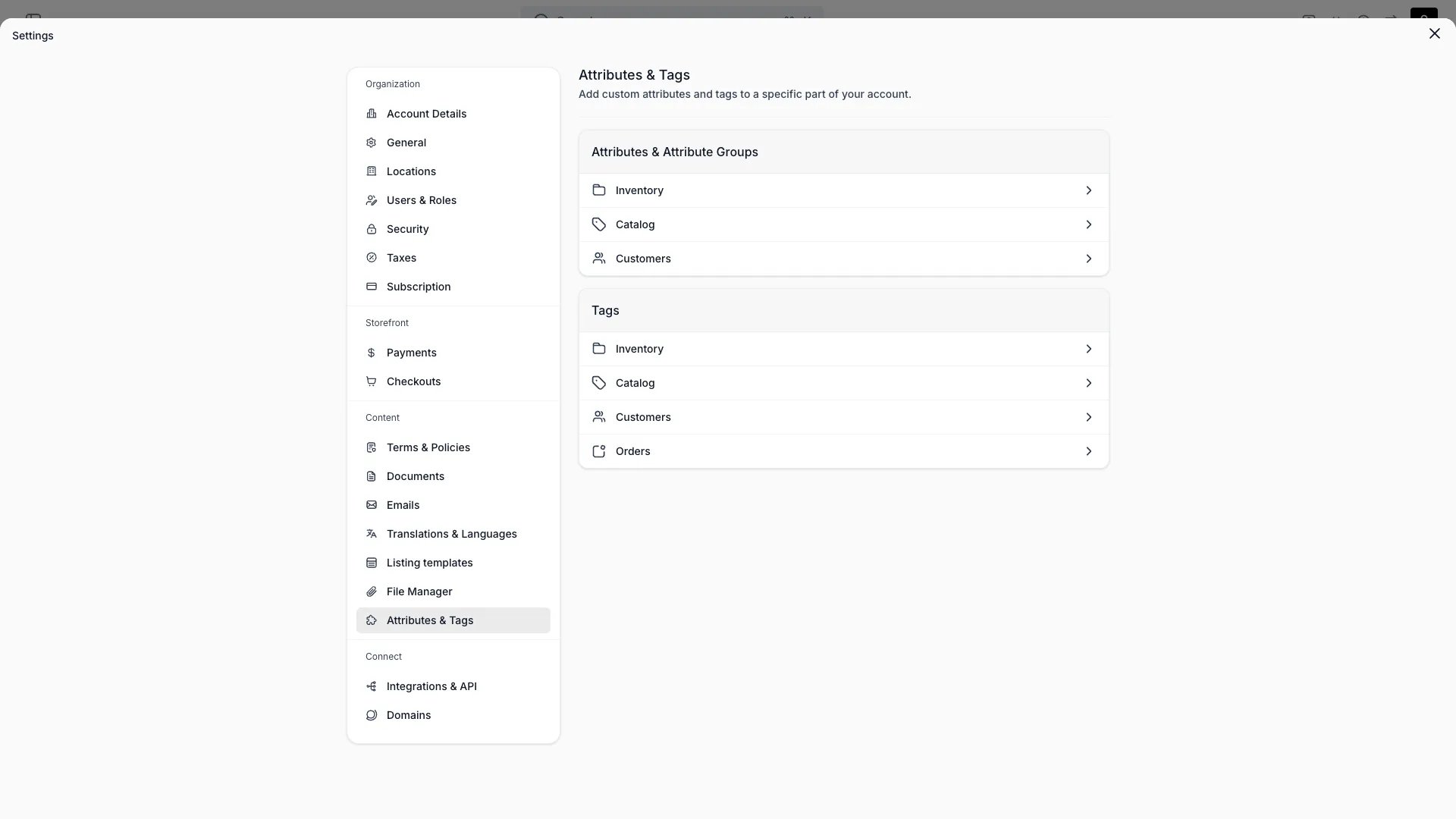
1. Open **Settings > Attributes & tags**
2. Pick the resource tab (Inventory, Catalog, Customer, Order)
3. In the Attribute Groups section, click **Add group**
4. Set name, optional description, and sort order
5. Assign existing Attributes to the group, or assign them later from the Attributes table
### Updating
* Rename, edit description, and reorder freely — display only, no data impact
* Drag-reorder groups in the table to change their `sortOrder`
* Move an Attribute into or out of a group at any time by editing the Attribute's `groupId`
### Deleting
* Deleting a group does **not** delete its Attributes — they simply move back to the default ("Details") section
* Bulk delete is supported from the table's row-selection tools
System groups (`system`) cannot be deleted.
## Working with groups in the API
Groups are listed and modified via the internal API:
When you create an Attribute, supply the `groupId` to place it in a specific group, or omit it to leave the Attribute in the default section.
## Relationships
```mermaid theme={null}
%%{init: {'flowchart': {'nodeSpacing': 20, 'rankSpacing': 30}}}%%
flowchart TB
subgraph ConceptBox["Data Organization"]
direction TB
Concept["**Attribute Group**"]
Resource["Resource (inventory / catalog / customer / order)"]
Concept ~~~ Resource
end
Attr1["Attribute 1"]
Attr2["Attribute 2"]
Attr3["Attribute 3"]
subgraph RelatedBox["Surfaces in"]
direction TB
AttributesTab["Entity Attributes tab"]
SettingsPage["Settings page"]
AttributesTab ~~~ SettingsPage
end
Concept -->|contains| Attr1
Concept -->|contains| Attr2
Concept -->|contains| Attr3
Concept -.->|drives layout of| RelatedBox
style ConceptBox fill:#0000000d,stroke:#888,stroke-width:2px
style Concept fill:#3b82f633,stroke:#3b82f6,stroke-width:3px,font-weight:bold
style Resource fill:#0000000a,stroke:#999,stroke-width:1px
style Attr1 fill:#10b98133,stroke:#10b981,stroke-width:2px
style Attr2 fill:#10b98133,stroke:#10b981,stroke-width:2px
style Attr3 fill:#10b98133,stroke:#10b981,stroke-width:2px
style RelatedBox fill:#f59e0b1a,stroke:#f59e0b,stroke-width:2px
style AttributesTab fill:#f59e0b1a,stroke:#f59e0b,stroke-width:1px
style SettingsPage fill:#f59e0b1a,stroke:#f59e0b,stroke-width:1px
```
## FAQs
No. An Attribute has exactly one `groupId` (or none, in which case it appears under the default "Details" section).
The group definition is removed but the Attributes are preserved. They move to the default section. To clean up Attributes too, delete or archive them separately.
No — Attribute Groups are a single level. If you need finer subdivision, create multiple groups and order them with `sortOrder`.
Groups organize Attribute definitions in Settings and on the Attributes tab. Tags are user-applied labels on records (Customers, Stock Items) used for segmentation and filtering. Tags don't affect form layout.
No. System groups (`system`) are managed by TWICE and don't count toward any group quota on your plan.
## Developer Reference
Attribute groups are exposed under the `attributes` tag in the API.
Open the endpoint in the API reference.
## Related
The fields that groups contain
Where you create and manage groups in the admin
Bulk-apply attribute sets when creating new Listings
How groups fit into the broader tab-based detail page layout
## Definition
An **Attribute Group** is a named bucket that holds related [Attributes](/docs/concepts/admin/attributes) for a single resource (Inventory, Catalog, Customer, or Order). Groups serve two purposes:
1. **Organization** — they keep your settings page legible as the number of Attributes grows
2. **UI layout** — they drive how the Attributes tab is divided on entity detail pages
**The analogy:** Think of an Attribute Group like a folder of related fields. The folder doesn't add new fields — it organises the ones you already have so they show up together everywhere they're used.
## How groups affect the UI
Every entity with Attributes — Stock Item, SKU, Listing, Customer, Order — has an **Attributes** tab. That tab is organised by Group:
* Each Group renders as a labeled section on the tab
* Attributes within a Group render in their `sortOrder`
* Ungrouped Attributes fall under a default section labeled **Details**
* Groups themselves render in their own `sortOrder` — you can drag-reorder them in the settings table
System-managed Attributes have their own special groups:
| System group | Resource | Used for |
| :----------- | :------- | :----------------------------------------- |
| `system` | Customer | Built-in customer fields like contact info |
System groups can't be deleted or renamed — they exist whether you've created your own groups or not.
## Key properties
An Attribute Group carries:
| Property | Type | Description |
| :------------------------ | :----------- | :------------------------------------------------------------ |
| `id` | UUID | Stable identifier |
| `name` | String | Display name (e.g. "Technical specifications") |
| `description` | String | Optional context shown in settings |
| `resource` | Enum | `inventory`, `catalog`, `customers`, or `orders` |
| `sortOrder` | Number | Position relative to other groups on the same resource |
| `attributeCount` | Number | Computed — how many Attributes currently belong to this group |
| `createdAt` / `updatedAt` | ISO datetime | Audit timestamps |
A Group is owned by exactly one resource. There is no cross-resource sharing — if you want similar groupings on both Stock Items and Listings, you create matching groups on each resource.
## Scope: one resource, one group
Unlike some platforms, TWICE doesn't let one Group span multiple resources. The reasoning is the same as for [Attributes](/docs/concepts/admin/attributes) themselves — each resource has its own schema, and mixing groups across resources would create coupling that's hard to reason about.
In practice, this means:
| You want... | You do... |
| :----------------------------------------- | :------------------------------------------------------------------------------- |
| "Specifications" group on Stock Items | Create a group on the `inventory` resource |
| The same "Specifications" idea on Listings | Create a parallel group on the `catalog` resource — independent identity |
| Bulk-apply a group to many entities | Use Listing Templates (for Listings) or bulk-edit (for Stock Items) — not groups |
## Lifecycle
### Creating
1. Open **Settings > Attributes & tags**
2. Pick the resource tab (Inventory, Catalog, Customer, Order)
3. In the Attribute Groups section, click **Add group**
4. Set name, optional description, and sort order
5. Assign existing Attributes to the group, or assign them later from the Attributes table
### Updating
* Rename, edit description, and reorder freely — display only, no data impact
* Drag-reorder groups in the table to change their `sortOrder`
* Move an Attribute into or out of a group at any time by editing the Attribute's `groupId`
### Deleting
* Deleting a group does **not** delete its Attributes — they simply move back to the default ("Details") section
* Bulk delete is supported from the table's row-selection tools
System groups (`system`) cannot be deleted.
## Working with groups in the API
Groups are listed and modified via the internal API:
When you create an Attribute, supply the `groupId` to place it in a specific group, or omit it to leave the Attribute in the default section.
## Relationships
```mermaid theme={null}
%%{init: {'flowchart': {'nodeSpacing': 20, 'rankSpacing': 30}}}%%
flowchart TB
subgraph ConceptBox["Data Organization"]
direction TB
Concept["**Attribute Group**"]
Resource["Resource (inventory / catalog / customer / order)"]
Concept ~~~ Resource
end
Attr1["Attribute 1"]
Attr2["Attribute 2"]
Attr3["Attribute 3"]
subgraph RelatedBox["Surfaces in"]
direction TB
AttributesTab["Entity Attributes tab"]
SettingsPage["Settings page"]
AttributesTab ~~~ SettingsPage
end
Concept -->|contains| Attr1
Concept -->|contains| Attr2
Concept -->|contains| Attr3
Concept -.->|drives layout of| RelatedBox
style ConceptBox fill:#0000000d,stroke:#888,stroke-width:2px
style Concept fill:#3b82f633,stroke:#3b82f6,stroke-width:3px,font-weight:bold
style Resource fill:#0000000a,stroke:#999,stroke-width:1px
style Attr1 fill:#10b98133,stroke:#10b981,stroke-width:2px
style Attr2 fill:#10b98133,stroke:#10b981,stroke-width:2px
style Attr3 fill:#10b98133,stroke:#10b981,stroke-width:2px
style RelatedBox fill:#f59e0b1a,stroke:#f59e0b,stroke-width:2px
style AttributesTab fill:#f59e0b1a,stroke:#f59e0b,stroke-width:1px
style SettingsPage fill:#f59e0b1a,stroke:#f59e0b,stroke-width:1px
```
## FAQs
No. An Attribute has exactly one `groupId` (or none, in which case it appears under the default "Details" section).
The group definition is removed but the Attributes are preserved. They move to the default section. To clean up Attributes too, delete or archive them separately.
No — Attribute Groups are a single level. If you need finer subdivision, create multiple groups and order them with `sortOrder`.
Groups organize Attribute definitions in Settings and on the Attributes tab. Tags are user-applied labels on records (Customers, Stock Items) used for segmentation and filtering. Tags don't affect form layout.
No. System groups (`system`) are managed by TWICE and don't count toward any group quota on your plan.
## Developer Reference
Attribute groups are exposed under the `attributes` tag in the API.
Open the endpoint in the API reference.
## Related
The fields that groups contain
Where you create and manage groups in the admin
Bulk-apply attribute sets when creating new Listings
How groups fit into the broader tab-based detail page layout